In this article
Vitamin C is skincare's benchmark antioxidant: it helps neutralise the free radicals generated by UV and pollution, supports the skin's own collagen production, and is widely used to brighten dull skin and fade the look of dark spots. It is also famously unstable — the pure form, L-ascorbic acid, oxidises in light and air — so form, concentration, pH and packaging decide whether a vitamin C serum is a good one. This guide gives you the checks.
What vitamin C is and what it does for skin
Vitamin C (ascorbic acid) is a water-soluble vitamin your body cannot make; in skincare it is applied topically at concentrations far above dietary relevance to exploit three documented roles. First, it is an antioxidant, donating electrons to neutralise free radicals before they damage skin structures — useful because sunscreen, while essential, does not block everything. Second, it is a required cofactor for the enzymes that build collagen, the protein framework whose decline shows up as laxity and lines. Third, it interferes with an enzyme step in melanin production, which is why it features in brightening routines aimed at uneven tone and sun spots.
None of this makes it a drug, and cosmetics cannot legally claim to restructure skin — but within cosmetic limits, vitamin C has one of the deeper evidence files of any fashionable ingredient.
The forms you will meet, and why they matter
- L-ascorbic acid — the pure, best-studied form. Needs a low (acidic) pH to penetrate, which is why good serums are formulated around pH ~3–3.5; that acidity is also why it can sting sensitive skin.
- Sodium ascorbyl phosphate (SAP) and magnesium ascorbyl phosphate (MAP) — stable, gentler derivatives that convert to ascorbic acid in skin; a common choice for sensitive or acne-prone users, with a smaller evidence base.
- Ascorbyl glucoside, THD ascorbate (tetrahexyldecyl ascorbate), 3-O-ethyl ascorbic acid — newer derivatives balancing stability, feel and conversion; THD is oil-soluble and suits dry skins.
A label that just says "vitamin C" without the form is giving you less information than you deserve; reputable serums name the derivative in the INCI list.
Strengths, and the packaging rules that protect them
Pure ascorbic acid serums are most commonly formulated between about 5% and 20%. Research on skin penetration suggests returns level off toward the top of that range while irritation keeps rising — which is why "maximum strength" marketing deserves scepticism, and why beginners are usually steered to the middle of the range. Derivatives are used at lower percentages and are not directly comparable number-for-number.
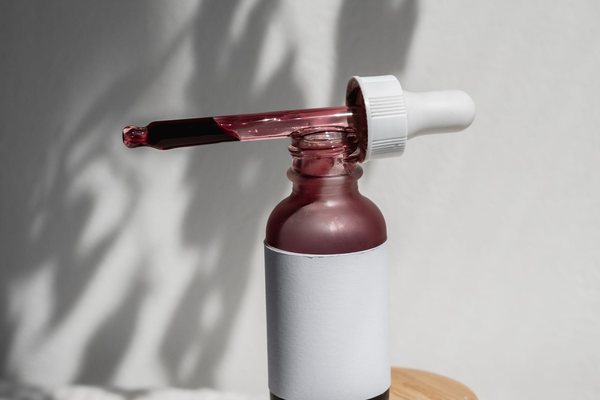
Packaging is half the product. Ascorbic acid oxidises to a yellow-orange and eventually brown solution that has lost its point, so look for: an opaque or amber bottle, an air-restrictive pump (droppers let air in at every use), and a product that is near-colourless to pale straw when new. If your serum arrives orange, it is already well down the oxidation road. Refrigeration is unnecessary; a cool drawer away from steamy bathroom air slows the decline.
Who it suits, and who should be careful
Vitamin C suits dull, sun-exposed, uneven-toned and "city" skin of most types, and it layers under sunscreen as a morning antioxidant step in many routines. Care is warranted for: very sensitive or eczema-prone skin (start with a derivative, or a low-strength ascorbic formula, a few mornings a week), skin already using strong exfoliating acids or retinoids (total irritation load matters more than any single product), and anyone whose serum has darkened — oxidised product is not dangerous, just pointless, and occasionally irritating.
Patch-testing a new active on a small area for a few days is the boring, correct advice, and it applies to vitamin C like everything else in this guide.
How to judge a vitamin C product on the shelf
- Form named? The INCI list should identify the exact derivative (e.g. "3-O-Ethyl Ascorbic Acid"), not hide behind "vitamin C complex".
- Percentage stated? Good brands disclose it for ascorbic acid serums.
- Partners present? Vitamin E (tocopherol) and ferulic acid are the classic stabilising partners — their presence signals a formulator who knows this chemistry.
- Packaging opaque and air-restrictive? A clear glass dropper bottle fails the brief.
- Position on the list? A hero ingredient should be in the top portion, not after the fragrance.
These five checks power our buying guide: best serums with vitamin C.
What it pairs with — and the bigger picture
Vitamin C's natural partners are sunscreen (they address the same enemy from two sides) and the barrier ingredients: niacinamide in a separate step or a well-made combined formula, and ceramides to keep the barrier comfortable while actives do their work. Modern formulations have largely solved the old vitamin C + niacinamide incompatibility warnings — those dated from high-heat laboratory conditions — but if a combined product irritates, separating them (C in the morning, niacinamide at night) is an easy experiment.
Vitamin C is the flagship of this ingredients to look for guide: effective, evidence-backed, and entirely dependent on formulation quality — the perfect case study in reading past the front of the bottle.
Frequently asked questions
What percentage of vitamin C should I start with?
For pure ascorbic acid, the middle of the common range — roughly 10% — is a sensible start for most people; sensitive skins often do better beginning with a gentle derivative (SAP or MAP) at its typical strength. More is not automatically better: penetration benefits plateau while irritation rises.
Why did my vitamin C serum turn orange?
Oxidation. Ascorbic acid reacts with air and light and degrades through yellow to orange-brown; the darker it gets, the less active it remains. Opaque, air-restrictive packaging slows this; a serum that arrives dark was likely old or poorly packaged.
Can I use vitamin C with niacinamide?
In modern formulations, yes — the famous incompatibility came from studies using extreme heat on pure powders. Well-made combined products exist. If you experience flushing or irritation with a combination, use them at different times of day and see if it resolves.
Morning or night?
Morning is the popular logic — antioxidant defence deployed before the day's UV and pollution, under sunscreen. Night use is not wrong; consistency matters more than timing for the tone and brightness goals.
Does vitamin C replace sunscreen?
No. It is an adjunct that deals with some of the free radicals sunscreen misses; it provides no meaningful UV protection rating itself. Think of it as the seatbelt's airbag, not the seatbelt.
Checked against US FDA, EWG Skin Deep cosmetics database, Journal of Clinical and Aesthetic Dermatology, Nutrients sources · Last updated 2026-10-22 · How we assess ingredients
Sources (5)
- US FDA — Cosmetics information
- EWG Skin Deep cosmetics database
- Journal of Clinical and Aesthetic Dermatology — Al-Niaimi & Chiang (2017): Topical vitamin C and the skin
- Nutrients — Pullar et al. (2017): The roles of vitamin C in skin health (PMC)
- Journal of Cosmetic Dermatology — Randomised controlled trial of 10% vitamin C serum over 12 weeks (2026, via PubMed)